-
Uncategorized
The William Major House
William Major House is located on Main Street and structurally still looks very much the same as in 1876 when this drawing of the house was published in the Crawford County Atlas. The spire at the top of the widow’s watch is gone now, but the watch still remains.
-
Uncategorized
Spartansburg Downtown 1876
Spartansburg was a flourishing village in the 1870’s. The population was growing and businesses were developing to meet the needs of the citizens. Grocery and Dry Goods stores, Blacksmiths, Saw Mills, Grist Mills, Harness Shops, as well as a hotel were among the businesses available
-
Dr. JT and AP Waid
Jason T and Adin P Waid worked as medical doctors and surgeons in Spartansburg in the 1870s and early 1880s. As seems to be true of all professionals of the time, both were actively involved in civic and social activities in Spartansburg. Adin Patten Waid was born in 1833 in Randolph Township. And died in 1903 in Buffalo. He had served as a physician there since leaving Spartansburg in 1883, following the death of his brother. His wife was Margaret. An obituary in the Titusville Herald indicates that he was injured during the 1898 Spartansburg fire and was confined to a wheelchair in his later years.https://www.findagrave.com/memorial/39014630/adin_patten_waid Jason Thomas was born…
-
1874 Directory for Spartansburg and Sparta Township
The 1874 version of the Crawford County Directory provided a list of residents of Sparta Township and Spartansburg Borough. The listing included the occupation of the resident. Those who lived in the township are designated with an r and a number after their names. 1874 Gazeteer and Business Directory for Crawford County 1874 Description of Spartansburg and 2 business ads
-
Uncategorized
The Lewis House
John M Lewis, Esq. owned and operated a wagon and carriage shop in the borough. He was well-respected for his workmanship and he was also a Justice of the Peace for Spartansburg. In 1874, he built a large brick home on the northeast corner of Main and Washington Streets. The home was briefly described in a June 10, 1874 Titusville Herald article. The home has changed little over the years and is still one of the few brick homes in the borough.
-
1871 and 1876 Directory
Crawford County printed and published a Business Directory frequently that included a listing of citizens and business owners in each community. These directories sometimes included advertisements and maps. The 1871 Directory The 1876 Directory
-
Lakeview (Hewell House) Hotel
One of the early businesses in Spartansburg was the Lakeview Hotel. In 1862, CW Hewell opened the St Nichlas Hotel on the northwest corner of Main and Water streets. During his proprietorship, the hotel was called by the name St. Nichlas and the Hewell House. During Hewell’s ownership, the hotel survived the first major fire (1878) that burned both sides of Main Street. In about 1886, Jerome Hyatt and his family took ownership of the hotel, and remained there through yet another fire in 1898. In 1899, Hyatt moved on and CE “Cap” Boyle became host to guests at the hotel. For the next several years, the hotel continued to…
-
Uncategorized
The Bates House
Mr. and Mrs. Fred Bates lived in this house on Mechanic Street These pictures are from about 1936. Currently, the residence is the PA Gast Haus Bed and Breakfast.
-
Tyler Tannery to Western Union Tannery
On the south side of Main Street, east of Oil Creek, John Willard Williams, then burgess of Spartansburg, built a tannery in 1869. (a tannery owned by J Ford is shown on a map from 1867) The creek was nearby to provide water needed for the process as well as potential power. The area around Spartansburg was well forested and provided the bark necessary for the tanning process. Men were employed to peel hemlock bark from the trees and haul it by teams of horses to be stored near the tannery. Children often played hide and seek around the bark piles. In the winter, children often hitched their sleds to…
-
Goldsteins’ Mercantile
With the mottos “Live and Let Live” and “A Satisfied Customer is the Best Advertisement” Goldstein’s Mercantile operated in Spartansburg from 1868 until 1915. The business was started in 1868 by Joseph Goldstein and his wife Libbie who were Russian immigrants. Mr. Goldstein was a well-respected merchant who also owned the Tyler Tannery from 1889 until 1891. When Joseph died in 1899, the business continued under Libbie’s name and managed by his son Abe. Abe was 18 at the time of his father’s death and had planned to attend Medical School. Under the name L. Goldstein, the store continued to prosper and to provide for the Dry Goods needs of…
-
Business Directory for circa 1867 and 1871
Spartansburg grew continually from its incorporation in 1856. As the area of Sparta Township grew, men and women met the needs of the community with their knowledge and skills. Miss Patty Blakeslee and Miss Phoebe Patton were among the first teachers in Sparta Township. Reverend Amos Chase served early churches and Dr. Horace Eaton met the medical needs in the area. Miss Ruth Gleason held class in a small school just west of the borough in 1833. By 1867, some of the earliest businessmen and tradesmen had moved on. Chauncey Akin’s bowl factory, William Bassett’s chair factory and John McWilliams tannery were closed or sold to others by the 1867…
-
School Building Erected in 1862
The first school in Spartansburg town limits was built on land donated by the Akins on the east side of Oil Creek (East Branch) In 1862, a modern new school was built on the corner of Water and Wood Streets. The wood construction building was 2 stories tall with 3 rooms on each floor. The Principal was Eli Catlin with Lizzie Akin and Eila Rorabeck as teachers. Six men served as the Board of Directors: Dr. AP Waid, TG Tyler, G Hilliker, WW White, CW Binney and WN Reno. Other schools served the students in the Spartansburg area prior to this building, but this school reached out to townships surrounding…
-
Railroads Through Spartansburg
The Oil Creek Railroad received a Charted in 1860. It was to connect to the Philadelphia and Erie Railroad and to the Atlantic and Great Western Railroad that came through Corry. The Oil Creek Railroad line from Titusville to Corry opened in 1862. That portion of the railroad traveled through Hydetown, Tryonville, Centerville, Glynden and Spartansburg over 27 miles. The Oil Creek became a part of the Western New York and PA, and later the Pennsylvania RR. The railroad provided opportunities for merchants and tradesmen in the area to expand their businesses and promoted Spartansburg’s growth.
-
Blacksmith Shops
At one time, Spartansburg hosted 4 blacksmith shops in the village. Luther and George Day, Charles Thompson, John McDannel, Charles Kinney and OD Snapp were some of the early smiths who cared for the blacksmith needs from 1871-1910. Their shops were located throughout the town. Information about Ayer’s Products: By the early 1900’s the role of the blacksmith was changing due to the entrance of horseless carriages. However, rural, farming areas still relied on wagons and horses to transport their families and crops. One of the last known blacksmiths in Spartansburg was Frank Herbst. He had a shop on Mechanic Street, 2 buildings up from the Methodist Church. Herbst sold…
-
Winans / Morris / Beal / Bates Hardware
AV Winans came to Spartansburg in about 1865 and established a butcher shop with his brother, SA Winans. Two years later he and his father-in-law purchased hardware stores owned by Alsdorfs and by CM Hopkins. AV Winans combined the 2 hardware stores into a building near the railroad track (northeast side of Main Street). This building was destroyed in the 1898 fire which burned the businesses on the NE side of Main from the tracks to Water Street. Shortly after the fire, he constructed a brick building (fire-resistant materials were required by city ordinance) on that site and continued with his business. This article from a 1908 edition of the…
-
Early Hardware Stores (Alsdorf / Burt / Thompson / Hilliker)
Hardware stores have served an important role in all small communities by providing those items that could not easily be crafted by individuals on their homesteads. Spartansburg has had many merchants who met the needs for various types of hardware. Blacksmiths were among the first to provide help with production and repair of metal tools and they would work with the merchants selling metal goods. One of the first hardware stores recorded in Spartansburg was the store built by Abram Alsdorf (Alsdurf) in 1874. This store was among those lost to the 1878 fire that destroyed all of the business district. An article in 1882 reported that Mr. Alsdorf was…
-
Baptist Church
The Baptist Congregation was begun in Bloomfield in 1820 and met in Concord Township. In 1849, organizers (listed below) brought a Baptist congregation to Spartansburg. The original church building was erected and dedicated in 1851. The church was described in the 1955 writings of Ralph Elliott Blakeslee as a “perfect specimen of New England Meeting House. That building was replaced by the current building on the same property in 1979. Organizers of the original congregation included: AJ Millard, A Matteson, Joseph Cook, John Carperner, Isaac Shreve and Benjamin Darrow. Spartansburg Baptist today. The new building was built on the same location as the original church building in 1979.
-
Presbyterian Church
The Presbyterian Church was organized in 1844. The church was built in 1849 on the South side of Main Street. The original pastors were George W. Hampson and Amos Chase. Oliver N. Chapin served as supply pastor for some time. Early members included: Eli Catlin, Wolcott Bennett, Mrs. Lula Smith. Joseph Culver, Isaac Brown, Charles and John Day, Isaac Farndon and William McLay. An active congregation was maintained until 1866. After the discontinuation of the Presbyterian congregation, the building was sold to the Congregational Church. Elders JT Waid and William Major served at the church along with Reverend MacKellar. Other members of the Congregationalists were:Homer Hall, WW Youngson, Peter…
-
The Tauber Woolen Mill (Previously Lamb)
Woolen manufacturing was among the earliest and longest lasting businesses in Spartansburg. As early as 1837, nearly 20 years before the borough was incorporated, McWilliams and Emerson developed a carding and fulling mill south of what would become the center of town. The business was at the end of what is now Mechanic Street and approximately where a lumber company is now (2021) In 1849, McWilliams sold his portion of the business to Mr. Lamb whose family later became sole owners and he made it into a Woolen Mill. The original mill building was maintained as a storage facility and a new 2 story factory was completed in 1862. Lamb…
-
Platt’s (Akins, Jude, Eldred and Thompson, Davis and Hyde, Platt & Steadman) Mill
Platt’s Mill on Mill Street beside the dam is the longest operating business site in Spartansburg. It was the original grist mill site begun by the Akins brothers in the 1830s on land purchased from Judge Barlow. The Akins also had a saw mill on the west side of Oil Creek. The mill was in a great location when the railroad came through town, and a siding from the main line to the mill further established its prominence. This portion of a map from 1867 shows the location of the saw and grist mills at that time. This 1876 map shows that the property for the grist mill had transferred…
-
Akins Brothers Begin Business in Spartansburg
In the 1830’s The Akins brothers, Andrew and Aaron, opened a Saw Mill and a Grist Mill on the East and West Side of Oil Creek. The Grist mill was on the site of the current Platt’s Mill. In 1837, Andrew Akin opened a General Store in Spartansburg. He employed Eli Catlin as a clerk. Catlin also purchased, surveyed and laid out the plan for the village.
-
Uncategorized
First Home in Spartansburg
The first log home in Spartansburg was built on the East side of Oil Creek by Abraham Blakeslee.
-
Uncategorized
Sparta Township Established
Sparta Township was originally a part of Mead Township, then Oil Creek Township. In 1829, Sparta was named a new election district. A Post Office and Election location was established at the George White Residence. That location is approximately where Route 77 and 89 divide SW of Spartansburg Map is from the Library of Congress: http://www.loc.gov/item/2012590195/
-
1820’s Saw Mills
In the 1820’s William Sterling and Akins started the first lumber businesses in Sparta Township. The mills were on tract of land purchased from the Holland Land Company and were on Patrick Run, just north of the future location of Spartansburg.
-
Patrick Run-Early Settlers and Murder
PLEASE NOTE: This post is a brief overview of the lives of Patrick and Hugh Fitzpatrick. For a more detailed study of their lives and deaths, check out the book Patrick’s Run by James McQuiston. The Fitzpatrick’s came from Ireland to settle on a tract of land acquired from the Holland and North America Land Company (Between Tract 286 and 398) Their stories are tales of hardship and demonstration of how unfair life can seem. Patrick was the father and he had been a seaman on Lake Erie before locating in Sparta Township. When the War of 1812 found its way to Erie and Commodore Perry, Patrick was sought out…
-
Uncategorized
About this site
Spartansburg History is work in progress. I welcome any photos, stories, articles or other historical items. I will care for them, digitize them and get them back to you. The information you will find here is based on stories, resources, pictures, news articles and some historic writings. Many of these resources have been shared, at my request, by folks whose families have lived here for multiple generations. The writings are as factual as possible. In many ways Spartansburg is a typical small rural village. But, after 34 years of life in this typical village, I have come to realize that the community spirit, sense of dedication and sincere concern for…
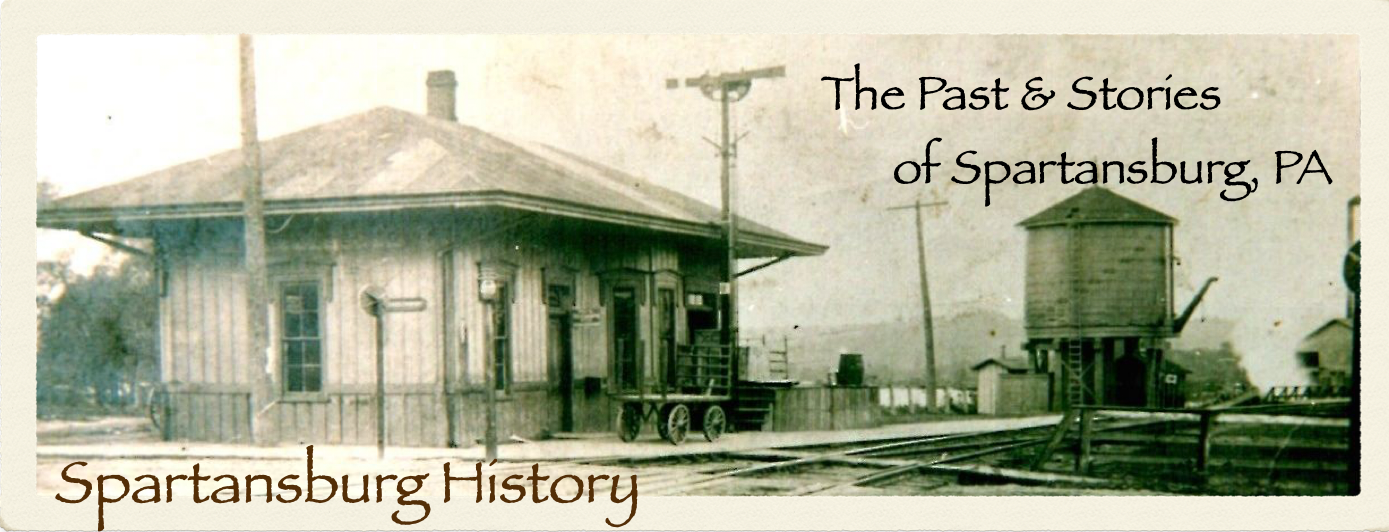
Spartansburg History
The Past and Stories of Spartansburg, PA


