-
The Edwards Family
The Edwards Family The Edwards Family came to the United States from Forfar, Scotland to Corry around 1871 and moved to Spartansburg about 1873. William and Elizabeth and their sons, James and William lived, worked and participated in the community from 1873 until 1903. William (Sr) had been apprenticed and worked as a stone mason in Scotland before re-locating here. As such, he is listed in Business Directories of the time and was probably actively involved in rebuilding the town following the fires of 1878 and 1898. Not much is known about Elizabeth, and little is recorded about their family life. Mr. Edwards was described as a craftsman in news articles. More about…
-
Shreve Chair Factory at Spartansburg
The Shreve Chair Factory in Spartansburg was located on the site of the early saw mill (started by the Akins brothers in about 1830) that was originally a part of what is now Platt’s Mill. The saw mill property passed through the ownership of John Jude and George Eldred and John Thompson. Eldred took over the management of the saw mill until it burned in 1894. Following his death in 1899, his estate sold 5 acres where the mill had been located to the Shreve Chair Company in Union City. (That property location was where part of Clear Lake Lumber operates now.) That sale was published in the August 17,…
-
Photographer~JP Hearn
James P Hearn served the photographic needs of Spartansburg, Waterford and Union City for several years starting in about 1875. This news article from the Titusville Herald, October 18, 1895 mentions Hearn. He likely had a small shop above one of the stores on Main Street where he worked a few days each month. Hearn was born in Devonshire, England in 1846. He immigrated to Canada in 1872 and studied photography there. He maintained a studio in Union City, rebuilding following a fire in 1879. He is included in the 1884 version of the History of Erie County: Here are some examples of Hearn’s photography in what was known as…
-
Piggly Wiggly
Grocery stores in the late 1800s and early 1900s, usually had clerks who would get the groceries for customers and bring them to a counter for them. Self-service stores came along later. One of the first to operate as self-service, was Piggly Wiggly. Here is the story of the first Piggly Wiggly stores according to Smithsonian Magazine. https://www.smithsonianmag.com/smart-news/bizarre-story-piggly-wiggly-first-self-service-grocery-store-180964708/ Piggly Wiggly came to Spartansburg in about 1934 on Main Street-probably replacing the Red & White Store-1 store in from the corner with Water Street. The manager was Laurence Winsor. His employees included Clair Lindsey, Mabel Schreckengost and Miss Helen Bates. The Piggly Wiggly sponsored contests- one prize was $5 and one…
-
Clear Lake Band
In 1904, a band, under the direction of Gustave Schmelzer was formed. Over the years, the membership changed, but concerts and parades were frequently attended by townsfolk to watch and hear our local musicians. Gus Schmelzer gave his baton to Abe Goldstein, but his support continued. Mr. Goldstein composed as well as directing the band and orchestra. There is no indication of a date when this concert was held, but the program must have taken a good degree of practice to prepare. The gazebo has since been removed-the Central Hotel (now Ashley’s Pub-2020) can be seen across the street.
-
Jay C Huff American Legion Post
Spartansburg organized an American Legion Post in 1920. The post was named after Jay C Huff who died in World War I. He is buried at Rose Hill Cemetery in Spartansburg. The Legion and Auxiliary were quite active in the town, holding dinners, managing an American Legion Home, sponsoring a summer carnival in conjunction with the Volunteer Fire Department, assisting with various service projects and serving as Honor Guard for military funerals. The post was mentioned in an American Legion publication in 1920 (page 11-12) recognizing their efforts as military escorts. They supported a scholarship named in memory of Miss Lucy Morris, a well-loved teacher and assisted in purchase of a…
-
Inventors and Patent Holders
Spartansburg has had its share of creative, inventive folks. Several patents have been received and inventions, ranging from the extremely useful to the slightly silly have come from our history. Not much information is available about some of the patents and inventions, but many related to the vocation of the inventor In 1858, John D. Akin received a patent for a musical instrument described below: In 1870, John H Dustan is one of many who was granted a patent for a washing machine. Could it have been used on something like this one? Link to Patent Furniture springs was the patent for JH Dustan and DW Akin in 1876. Link…
-
Hardware: Most’s to Bova’s
In 1968, the hardware that had been owned and run by Fern Beale and the Bates, was purchased by Herbert Most and his wife Marlott who had come to the US from Germany in 1951. They owned the store until 1989. The store was in the same location built by Leon Morris in 1899. As with all the previous owners, the hardware was an important part of the community. Collections for the March of Dimes, Red Cross and local fund-raising were made at the store. Displays for Boy Scouts, Girl Scouts and school teams were often found in the windows. In 1971, yet another fire destroyed a business on the…
-
Catholic Church
The Catholic Church has had a presence in Spartansburg for many years. Services for Catholic residents of Spartansburg and the surrounding area were provided by missionary priests in the mid 1800s. Starting in 1906, Father Kuntz, from Corry, held Mass once a month. He was followed by Father David Hartnett who met with parishioners once a month in the home of William Bliley The Blileys provided a portable altar and 2 benches for those who came to gather near the pot-belly coal stove. Mrs. Bliley tended the altar linens and vestments. When a larger congregation required more space, stores were rented for services. Upon the retirement of Father Hartnett, Father…
-
OSMO Tannery (1933-1989)
As a part of his duties at the Tauber Woolen Mill, Walter Pfeiffer traveled and visited many businesses that were associated or enhanced the woolen trade. On one such trip to Cleveland, Ohio in 1932, Walter met and toured the OSMO Manufacturing Company owned by Oskar Most. His business was in the tanning and production of items made from sheep hides. Most had come to the US in late 1920s and had operated the business in Cleveland for about 2 years. He was interested in locating in a smaller community where costs might be lower. Pfeiffer convinced him to visit Spartansburg and move his business here. In 1933, with Pfeiffer…
-
Spartansburg Fair
Spartansburg folks enjoy celebrating. Parades, carnivals, dances, dinners, picnics and gatherings of all sorts have been reported since the late 1800s in the busy borough. Carnivals and parades were often held to mark the opening of a new business, for example the opening of the Edwards Woolen Mill in 1898, and the opening of the Grange National Bank. So, it is no wonder that 158 years after the establishment of Spartansburg as a town, we are still celebrating. The Spartansburg Fair is Born The main celebration time for us is the Spartansburg Community Fair- in 2014, the 93rd Fair. While several fair-like events had been held, sometimes more than once…
-
Dooher Hardware and Grocery
Peter Joseph Dooher (PJ) and his wife Flora (Whaley) came to Spartansburg before 1910. He served as a depot operator and telegrapher for the Pennsylvania Railroad from about 1910 until he retired about 1940. During part of this time, he also owned and managed, with his family, a grocery and hardware store in town. The store was in what was known at the time as the Winans Block. (In 2017, that building houses Walton’s Cabin and The Spartansburg Pharmacy.) The building was constructed following the 1898 fire that destroyed the north side of Main Street. This picture shows the gasoline pump that Mr. Dooher had installed in 1921 according to…
-
Rexford Drug Store
On the southwest corner of Main Street and Mechanic Street, a large brick building was erected after the 1878 fire that destroyed both sides of the Main Street business district. Initially, this building housed the CW Kinney grocery store, later called the Diamond Grocery. About 1911, the store became a drug store and jewelry store owned by the Rexford family with partners. One of these partners was BL (Bert) Miller who purchased a business from CH Gabriel in about 1907. More can be found about BL Miller in an article about him. The druggists, Rexford and Allen were involved in some legal difficulties in 1914. Morphine was sold in an…
-
Dr. E.E. Maitland
Dr. Elmer Maitland arrived in Spartansburg in 1903, having purchased the practice of Dr. P Fisher who had served the community since before 1895. Dr. Maitland and his wife Allie and daughter Leota lived on Mechanic Street. The house has since been demolished and is part of the property now housing Spartansburg Regional Health Center. Dr. Maitland’s practice continued until 1927. During this time, he was an active participant in the community as well as a respected physician. He handled vaccinations for several area schools and was called upon in 1916 to determine the sanity of a man found wandering a rural area near Centerville. The man was from…
-
Dr. CT and Dr. GT Waggoner
Charles Thatcher Waggoner (CT Waggoner) The first mention of Dr. Charles T Waggoner in Spartansburg was in 1897. He and his wife, Rose, had a son, George, who was born in Spartansburg in 1898. Rose passed away in 1902. Dr. Waggoner was here in 1898 when fire attacked the Northeast side of Main Street. He and his colleague, Dr. HK Green, had been members of fire departments in other cities. They were reported to have helped to direct the firefighting effort and were credited with preventing the fire from crossing Main Street while the citizens kept the bucket brigade going. Dr. CT Waggoner saw patients in his office and went…
-
BL (Bert) Miller-Druggist
BL Miller came to Spartansburg from Williamsport in Summer, 1905 having purchased the business of CH (CA) Gabriel at auction, following the failure of the Spartansburg Bank. (Gabriel was a guarantor of the bank) . He had several years of experience as a druggist and advertisements and articles indicated his success. During this time, another drug store, owned by the Rexfords, was also operating in Spartansburg. In about 1907, Miller and Rexford became partners and Miller purchased a large storefront on the southwest corner of Main and Mechanic Streets (built following the 1878 fire by the Kinneys) that had been the SpartaBargain Store. Rexford and Miller combined their businesses in…
-
Evert Frost-Watches and Jewelry
In the late 1890s and early 1900s, Everett (Evert) Frost and wife, Edna, lived in Spartansburg where he owned a watch and clock repair and jewelry business. His store was on Main Street. Mr. Frost advertised in the Spartansburg Sentinel, in some creative ways. Everett was raised in Little Cooley and had a clock shop in Riceville prior to the one in Spartansburg. He and Edna had one child, a son Ivan who died at age 11 when the family had moved to Fredonia, NY. The three are interred at Rose Hill Cemetery. It seems that he was divorced and re-married (Bessie Sherlock) after leaving Spartansburg. He adopted Bessie’s 2…
-
Firemen’s Carnivals and Dances
Spartansburg Firemen sponsored many events, often for fund-raising for the VFD and other organizations. One event was the Firemen’s Carnival. The first carnival was held in 1948 and was in conjunction with the American Legion to raise money for the American Legion Home. Several other carnivals were held in the next few years. The firemen also hosted dances and other social events at the firehall building on Mechanic Street. The building was originally the New Era Temple on Mechanic Street.
-
Dr. H K Green
Dr. Homer Kenyon Green was born in New York in 1848. He was a dentist in Titusville before coming to Spartansburg sometime before 1890. He offered dental services in his offices on Mechanic Street, East Main Street (in a home that burned in 1903), and West Main Street. He assisted dentists in Titusville during this time as well. This advertisement ran for several weeks in the Titusville Herald in 1893 and 1894. Note that he will refund rail fare on large orders of false teeth. Dr. Green was married 3 times. Elizabeth died shortly after their marriage. Catherine and Homer had 1 child, Lelia, and were divorced. His marriage to…
-
The Edwards Woolen Mill
The Edwards Brothers (James and WIlliam), with the help of the town, constructed and operated a woolen mill. Two acres of land at the end of Water Street were donated and “subscriptions” were sold to raise funds for construction and machinery. The mill was in operation from 1896 until 1902. A fire damaged the building and the Edwards’ Mill was re-located to Siverly (Oil City) in 1902. The Edwards Brothers’ family home is featured here. These news clips are from the Titusville Herald: April 10, 1896 June 5, 1896 July 7, 1896: The Merchant’s Carnival was held in honor of the completion of the Mill Building. A parade was held…
-
The Taubers
The Tauber family held a prominent place in the Spartansburg community. As owners and managers of the Tauber Woolen Mill, they provided employment as well as products that brought recognition to the town. Martin Tauber purchased the Lamb Woolen Mill in 1898. He came from Maryland and only owned the mill for seven months before his death. John and Charles Tauber (brothers) took over the ownership following their brother Martin’s death. John remained with the company until 1910 and he invented a piece that made manufacture of the “comfort” quilt possible. 1913 Patent for Mechanism for Knitting Fleece-lined Fabric An article appeared in 1916 Textile World Magazine about the invention…
-
The Lamb House
The land was first purchased by Harvey (Major) Lamb from John Emerson in 1852. Lamb built the house circa 1870. Lamb owned the Lamb Woolen Mill at the end of Mechanic Street (later Tauber Mill) The home passed through other families, including John and Charles Tauber, Flora Patchen, HB Drought and William Foster. Following the Droughts’ ownership, in 1944 the building was sold to Paul Blakeslee who lived there until 1946. Shortly thereafter, it became the American Legion Home. The Jay Huff Legion Post and Auxiliary began to raise funds to allow them to improve the property. They made a number of repairs and updates to the home in 1956. …
-
Gustav Schmelzer Shoes and Boots
With thanks to Gustav’s Great Grandson, Robert for sharing information and photos of Gustav and some of his tools and wooden travel chest. Gustav A. Schmelzer was a prominent and respected merchant and tradesman in Spartansburg for 37 years. He was born in Bavaria (at that time it was separate from Germany) and had 3 brothers. Gustav served his country and was wounded in the Franco-Prussian War, after which he came to America. Two of his brothers, Emil and Franz also came to the US and settled in Buffalo and Erie respectively. He had just begun business, working in a building on the north side when the 1878 fire destroyed…
-
Ray Harroun
The winner of the 1st Indianapolis 500 was born and raised in Spartansburg. He was the son of Russell and Lucy (Halliday) Harroun and was born January 12, 1879. Erie News Now, John Last, featured Ray Harroun in a 2024 “The Last Word” and on his YouTube Channel His dad was a carpenter who became the Spartansburg Postmaster in 1880. Harroun spent his early years in the home that his father built on Washington Street. That home still stands. The family lived in the area for several years before moving to Ohio in about 1899. Following high school graduation, he entered the US Naval Academy where he earned a degree…
-
Dr. JT and AP Waid
Jason T and Adin P Waid worked as medical doctors and surgeons in Spartansburg in the 1870s and early 1880s. As seems to be true of all professionals of the time, both were actively involved in civic and social activities in Spartansburg. Adin Patten Waid was born in 1833 in Randolph Township. And died in 1903 in Buffalo. He had served as a physician there since leaving Spartansburg in 1883, following the death of his brother. His wife was Margaret. An obituary in the Titusville Herald indicates that he was injured during the 1898 Spartansburg fire and was confined to a wheelchair in his later years.https://www.findagrave.com/memorial/39014630/adin_patten_waid Jason Thomas was born…
-
Tyler Tannery to Western Union Tannery
On the south side of Main Street, east of Oil Creek, John Willard Williams, then burgess of Spartansburg, built a tannery in 1869. (a tannery owned by J Ford is shown on a map from 1867) The creek was nearby to provide water needed for the process as well as potential power. The area around Spartansburg was well forested and provided the bark necessary for the tanning process. Men were employed to peel hemlock bark from the trees and haul it by teams of horses to be stored near the tannery. Children often played hide and seek around the bark piles. In the winter, children often hitched their sleds to…
-
Goldsteins’ Mercantile
With the mottos “Live and Let Live” and “A Satisfied Customer is the Best Advertisement” Goldstein’s Mercantile operated in Spartansburg from 1868 until 1915. The business was started in 1868 by Joseph Goldstein and his wife Libbie who were Russian immigrants. Mr. Goldstein was a well-respected merchant who also owned the Tyler Tannery from 1889 until 1891. When Joseph died in 1899, the business continued under Libbie’s name and managed by his son Abe. Abe was 18 at the time of his father’s death and had planned to attend Medical School. Under the name L. Goldstein, the store continued to prosper and to provide for the Dry Goods needs of…
-
Blacksmith Shops
At one time, Spartansburg hosted 4 blacksmith shops in the village. Luther and George Day, Charles Thompson, John McDannel, Charles Kinney and OD Snapp were some of the early smiths who cared for the blacksmith needs from 1871-1910. Their shops were located throughout the town. Information about Ayer’s Products: By the early 1900’s the role of the blacksmith was changing due to the entrance of horseless carriages. However, rural, farming areas still relied on wagons and horses to transport their families and crops. One of the last known blacksmiths in Spartansburg was Frank Herbst. He had a shop on Mechanic Street, 2 buildings up from the Methodist Church. Herbst sold…
-
Winans / Morris / Beal / Bates Hardware
AV Winans came to Spartansburg in about 1865 and established a butcher shop with his brother, SA Winans. Two years later he and his father-in-law purchased hardware stores owned by Alsdorfs and by CM Hopkins. AV Winans combined the 2 hardware stores into a building near the railroad track (northeast side of Main Street). This building was destroyed in the 1898 fire which burned the businesses on the NE side of Main from the tracks to Water Street. Shortly after the fire, he constructed a brick building (fire-resistant materials were required by city ordinance) on that site and continued with his business. This article from a 1908 edition of the…
-
Early Hardware Stores (Alsdorf / Burt / Thompson / Hilliker)
Hardware stores have served an important role in all small communities by providing those items that could not easily be crafted by individuals on their homesteads. Spartansburg has had many merchants who met the needs for various types of hardware. Blacksmiths were among the first to provide help with production and repair of metal tools and they would work with the merchants selling metal goods. One of the first hardware stores recorded in Spartansburg was the store built by Abram Alsdorf (Alsdurf) in 1874. This store was among those lost to the 1878 fire that destroyed all of the business district. An article in 1882 reported that Mr. Alsdorf was…
-
Presbyterian Church
The Presbyterian Church was organized in 1844. The church was built in 1849 on the South side of Main Street. The original pastors were George W. Hampson and Amos Chase. Oliver N. Chapin served as supply pastor for some time. Early members included: Eli Catlin, Wolcott Bennett, Mrs. Lula Smith. Joseph Culver, Isaac Brown, Charles and John Day, Isaac Farndon and William McLay. An active congregation was maintained until 1866. After the discontinuation of the Presbyterian congregation, the building was sold to the Congregational Church. Elders JT Waid and William Major served at the church along with Reverend MacKellar. Other members of the Congregationalists were:Homer Hall, WW Youngson, Peter…
-
The Tauber Woolen Mill (Previously Lamb)
Woolen manufacturing was among the earliest and longest lasting businesses in Spartansburg. As early as 1837, nearly 20 years before the borough was incorporated, McWilliams and Emerson developed a carding and fulling mill south of what would become the center of town. The business was at the end of what is now Mechanic Street and approximately where a lumber company is now (2021) In 1849, McWilliams sold his portion of the business to Mr. Lamb whose family later became sole owners and he made it into a Woolen Mill. The original mill building was maintained as a storage facility and a new 2 story factory was completed in 1862. Lamb…
-
Platt’s (Akins, Jude, Eldred and Thompson, Davis and Hyde, Platt & Steadman) Mill
Platt’s Mill on Mill Street beside the dam is the longest operating business site in Spartansburg. It was the original grist mill site begun by the Akins brothers in the 1830s on land purchased from Judge Barlow. The Akins also had a saw mill on the west side of Oil Creek. The mill was in a great location when the railroad came through town, and a siding from the main line to the mill further established its prominence. This portion of a map from 1867 shows the location of the saw and grist mills at that time. This 1876 map shows that the property for the grist mill had transferred…
-
Akins Brothers Begin Business in Spartansburg
In the 1830’s The Akins brothers, Andrew and Aaron, opened a Saw Mill and a Grist Mill on the East and West Side of Oil Creek. The Grist mill was on the site of the current Platt’s Mill. In 1837, Andrew Akin opened a General Store in Spartansburg. He employed Eli Catlin as a clerk. Catlin also purchased, surveyed and laid out the plan for the village.
-
1820’s Saw Mills
In the 1820’s William Sterling and Akins started the first lumber businesses in Sparta Township. The mills were on tract of land purchased from the Holland Land Company and were on Patrick Run, just north of the future location of Spartansburg.
-
Patrick Run-Early Settlers and Murder
PLEASE NOTE: This post is a brief overview of the lives of Patrick and Hugh Fitzpatrick. For a more detailed study of their lives and deaths, check out the book Patrick’s Run by James McQuiston. The Fitzpatrick’s came from Ireland to settle on a tract of land acquired from the Holland and North America Land Company (Between Tract 286 and 398) Their stories are tales of hardship and demonstration of how unfair life can seem. Patrick was the father and he had been a seaman on Lake Erie before locating in Sparta Township. When the War of 1812 found its way to Erie and Commodore Perry, Patrick was sought out…
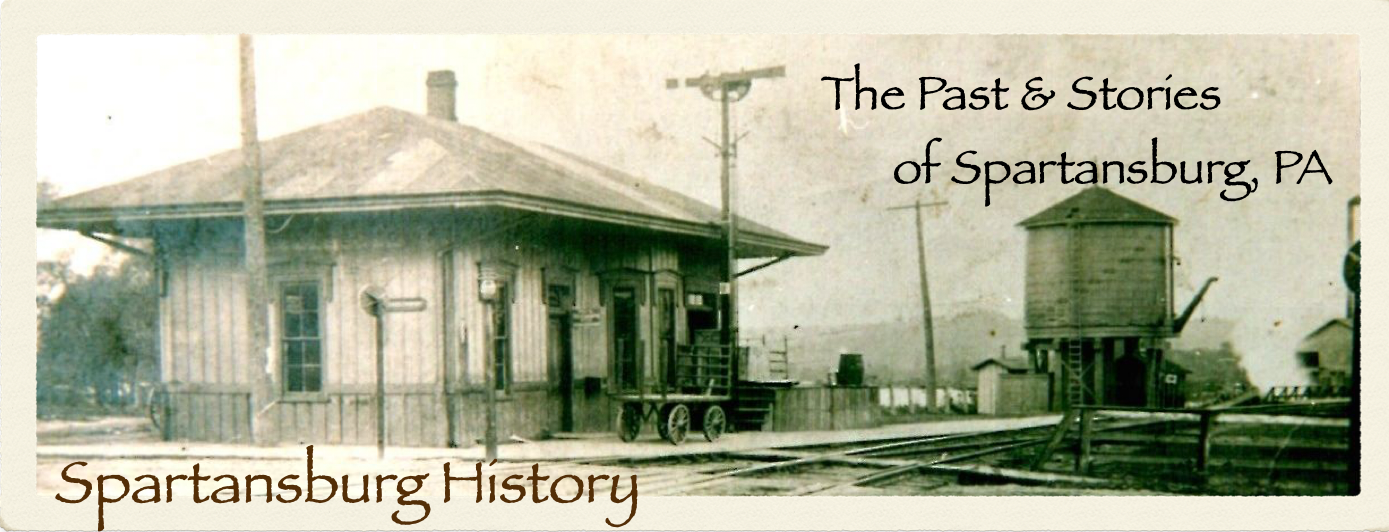
Spartansburg History
The Past and Stories of Spartansburg, PA


